Ash and Lil do India - Blog 10 - From Rishikesh to New Delhi
So here we are, sitting in a 7-seater car going to Delhi: one Muslim, two Hindus, and two newly hatched mediators.
“Are you changed? Have you unstressed?” Ravi asks us, curious that we have flown across the world to navel-gaze. He says Indians can’t tell you what stress is, as they don’t have it, then contradicts himself, saying, “Mohan is more stressed, as I am a very less stressed person,” and “white people hurry for nothing.”
Ravi has given me an Indian name, Asa, meaning hope, and we continue to call each other husband and wife with a straight face, as if we have been a couple for a long time. Ravi says he believes in karma, but that it is in the moment, not later: “I saw you. I felt you needed help. I say to Mohan, ‘Go ask them.’ I did something good, and now we are having a good day.”
Lil and I could not possibly have found two more delightful guides. The four of us are like schoolchildren on the way to see the sea for the first time. There really is nothing as rewarding as the company of intelligently curious people who seek and share knowledge. They show us India not just as locals, but as locals whose personalities and innate curiosity have driven them to learn about their country, the world, and the English language. They have never been on a plane.
The first city we come to is Haridwar, which is one of the three very holy cities in India from where bodies are thrown into the Ganga; the others are Prayagraj and Varanasi.
According to our self-appointed guides, Hindus believe we have many lives, and the fastest way to get on with your next life is to recycle the spirit by burning the body first, then throwing it into Mother Ganga’s arms, as she has unique self-purifying properties which help disintegrate the body in a few weeks (but only in the rural areas).
Before the body is cast on the pyre, it lies on the floor, which has been specially cleaned with cow dung (gobar). Hindus believe that if a person is not really dead, contact with the earth will make the body spring back to life. Babies are not burned, but thrown straight into Mother Ganga’s arms, as their souls are pure and have not yet attached to their physical bodies.
If you die by being bitten by a snake, or from a disease that makes your face mottled, you are thrown in without being burned. If you are burned after sunset, you will be reincarnated blind. Women don’t go to the burning part of burials, just the throwing-into-the-Ganga part.
Every family has a special brahmin who writes deaths up in a special book, which enables every person in India to be able to trace their family history for at least 500 years.
I ask why no one speaks English in India, and Ravi, the chief spokesperson for the two, tells us the British only educated a small elite selection of Indians, which is why a lot of Indians over 30 don’t speak English, but he says the under-30s are now speaking so much English they aren’t bothering to read and write Hindu.
In a brief history lesson, Ravi says the British left India in 1947 after 200 years. “We are completely free now, but because we are 5000 years old, we stay the same. We have never changed. The British were better than the Mongols, who destroyed everything. Yes, the British took our gold ($45 trillion in today’s value) and our IP, but the British gave us good laws, built railways, and they built a bridge that is still here 100 years later. It wouldn’t last that long if it had been built by Indians, and they only hang off trains in Mumbai and Bangladesh.”
He continues: “Women stay at home in the countryside, but their role is changing in the cities. Beggars are actors who make more than us. 10 million people don’t have enough to eat, but Indians look after each other and their animals. Farmers are being driven off their land, as they are unable to repay their loans, and corporate expansion is forcing them into urban poverty.
“There are four castes, which were officially abolished in 1948 but still remain the chief determinant of social life, especially marriage and occupation.
Brahmins — head, brain, knowledgeKshatriyas — strength, army, wealthy (Singh)Vaishyas — stomach, work, farmers (Patel)Shudras — labourers, service providers, artisans.
Untouchables are excluded from the four-tier varna Hindu system, as they are considered ‘polluting.’”
Ravi concludes his history lesson by saying, “People wear lots of clothes, even when it’s not so cold. The people of New Delhi are dying from the pollution. Private schools are created to ensure higher-class people stay higher class. Cleaners come from Bangladesh now, and the rickshaw is the most weird vehicle.”
When I ask why Indians leave India, Ravi says, “Indians always think the grass is greener on the other side.” He says Indians are abandoning their religion, as the West holds a fatal attraction for them.
Paradoxically, as they abandon their spiritual beliefs, Westerners are adopting them, as the people of the West became lost when they abandoned their own religion, yet religion (or spiritual beliefs) defines a culture. When the West abandoned religion, a multitude of bad people like Hitler and Trump were born. There was a shortage of good people in the West, which meant a shortage of good parents, which meant Western souls on their last journey to enlightenment found it hard to be born.
Ravi says sometimes many centuries pass before a yogi or guru arrives, and the word “God” stands for:
G — generator, physical RamaO — operator, energy giver of life, VishnuD — destroyer, after-life regeneration, Shiva
Rohan asks Lil if she paints her hair. She says it has been like that from childhood. We all agree her hair is silver.
We leave Rishikesh at 11 and arrive in Delhi at 9. The trip should take five hours, but takes ten, as it truly is the journey, not the destination, with these two characters.
Our handsome Muslim driver gets into the spirit of things and pulls up every time he sees something he thinks might interest us. We see mango and papaya growing; buffaloes, camels, and oxen pulling sticks along highways; small chimneys puffing out burning bricks; an old man collecting rubbish on his cart; people wandering by with bricks on their heads; and little campfires lighting up dwellings on the side of the road and in the middle of roundabouts.
We see sugar cane being turned into Batahsa by bearded men squatting over open steaming vats. I am given a lump of sugar and, in my ridiculous, priggish, uptight Western way, I worry it will give me Delhi belly, and I secretly throw away this treasure and am ashamed.
When I take a photo, my subjects want a photo back, as white people are still uncommon in rural India. India seems not a place the world wants to see, and so it has not remodelled itself as a tourist destination, but for now remains true to itself.
Just as we draw near to the airport, we see a most marvellous golden statue, and Ravi says this is the Swaminardham Akshardham temple (eternal dwelling of God). Nothing will do but we must see this, and our friends graciously agree, as it seems Indians cannot say no to any proposition.
As we get closer, we see this beautiful temple rising from the rubble like a flamingo in the trenches. We pass through security, which is just a woman giving us little paper tickets for our phones, which she puts in little wooden cubicles, and in this primitive fashion thousands of Indians swarm through the gates. We are the only white people.
We take off our shoes as we enter the hallowed grounds, made all the more holy by the aura created when everyone is taking pictures with their hearts, not their phones. Just for a moment, we are quite simply breathless, stunned by a beauty created by man that rivals the beauty of God’s paintbrush. I think God would be proud of himself for creating a species that could create something of such beauty.
We stand in a massive dome made entirely of intricately carved white marble, with enclaves dedicated to all the various gods. It was built in 2005 by our contemporaries, so it just shows what marvels man can create if that is what he chooses to do.
We stop briefly in New Delhi to go to a money machine. The streets are so crowded it’s like going to a rock concert; the crowds are heaving, the street vendors are selling, and everyone seems to know what they’re supposed to be doing, like the emergency room in a hospital.
We leave this surf beach behind to fly home to our pond, but an invisible thread of friendship binds us forever to India.
Adieu Ravi and Rohan… till we meet again.

Love letters

Shiva, the most popular deity.

Real beauty

How to make a living

Putting it in the boot

C'est la vie
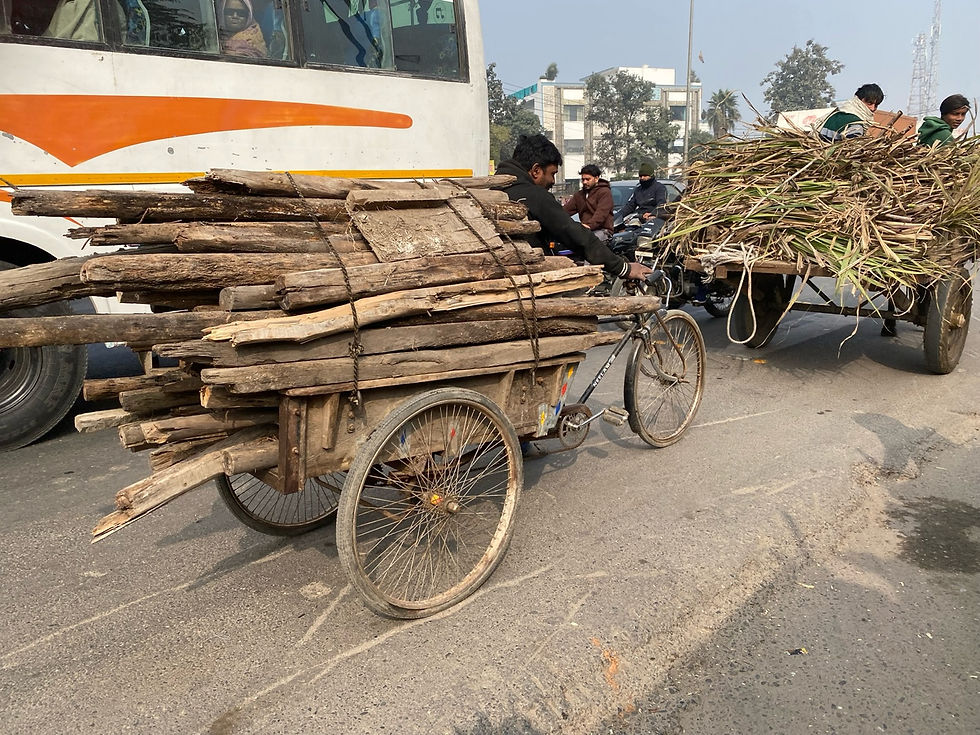
Earning a buck

Riding with the roof up

Making Batahsa

Fruit world

The elements

Horse and cart
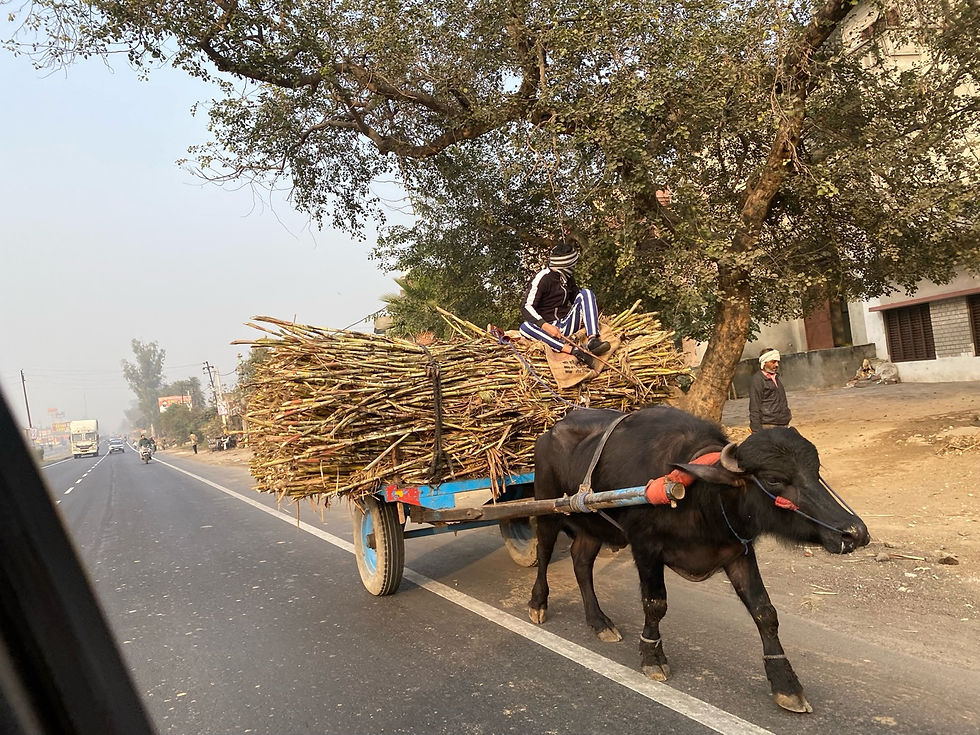
Sticks and stones

Traffic jam

Indian advertising

A shepherd and his herd


Comments