Ash and Lil do India - Part 2 - The Taj Mahal!
Lil and I share the highway with dogs and cows as we drive to Agra, a town that booms because a Mongol emperor wanted to build the biggest mausoleum in the world for his wife. She died bearing his fourteenth child, and when she wasn’t having his children she used to go to battle by his side. She encouraged him to build this monument to her, and now, 400 years later, she still wins, hands down, as having the biggest grave in the world—where she lies, getting trampled on by ten million pairs of feet a year.
We have a special guide called Sumit to make sure we skip the queues, don’t get mobbed by beggars and street vendors, or bitten by monkeys—which bit him once, but he doesn’t elaborate except to say he is inoculated against rabies. His English is not bad, considering: “I has never been in any countries,” which translates as, “I have never been on a plane.” He says he has a degree in history and is a palm reader. He looks at Lil’s hand and says she has been very ill. She laughs and says politely that, as far as she knows, she hasn’t. Then he says, “You have had many jobs,” and she asks diplomatically if two qualify as many in India.
When we arrive at the Taj, Lil stands silently—words like amazing, diminished by overuse, rendering her lost for words. She is a blonde statue amongst 53,000 Indians. They ask for photos with us, especially Lil. Most of them are dressed in wedding finery as they come to the Taj—not, Sumit says sadly, to listen to his history of the love story of a Mongol king, but to begin their own love story. Weddings are the way parents of the betrothed show anyone who cares what they have achieved in their life. It is the day they toil and save for all their lives, and the day when they can henna their hands.
Lil finally speaks and says, “The Taj Mahal is the most beautiful thing I have ever seen.”
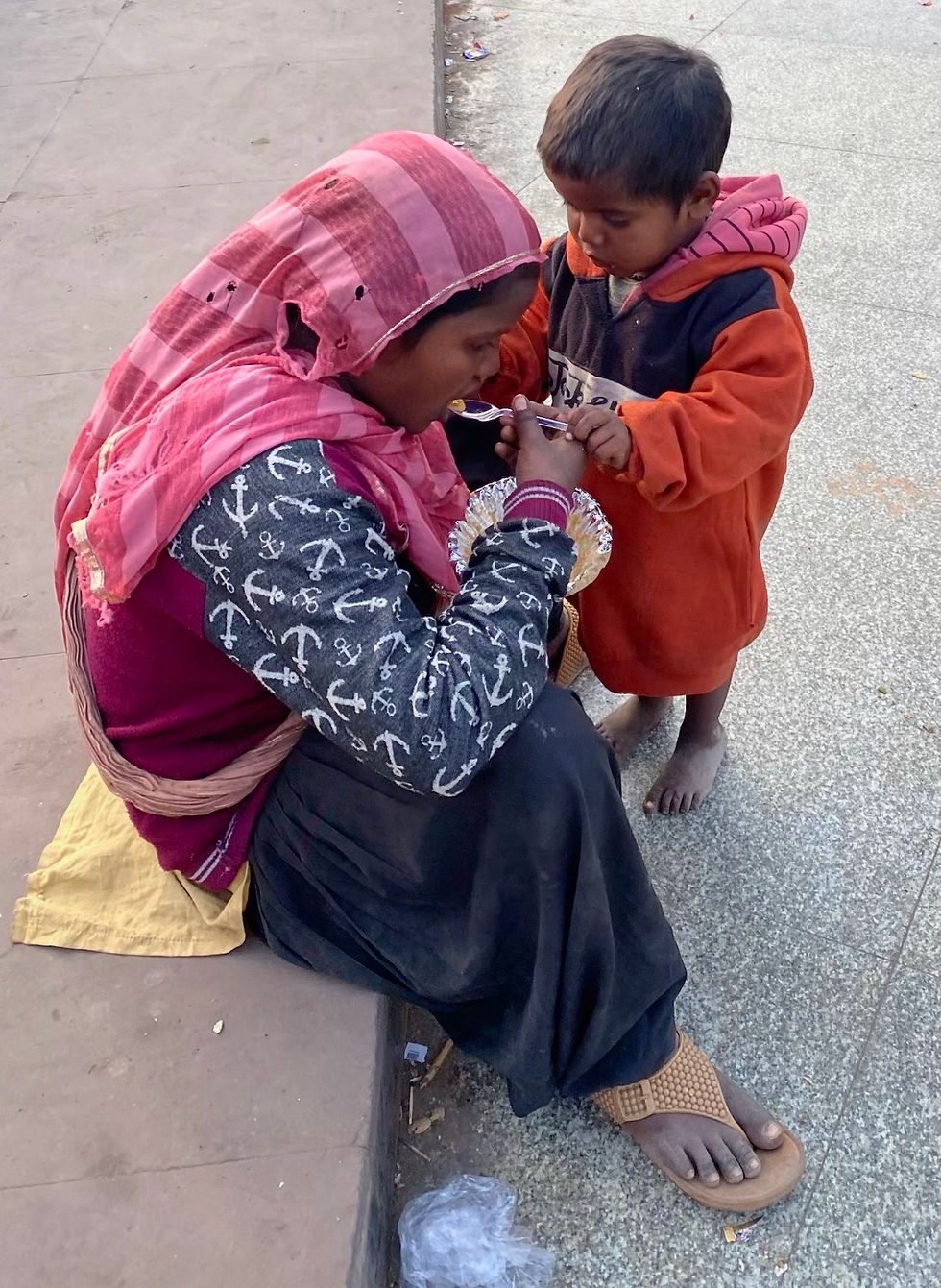
I feel uneasy. While the king who built it swims at the top of the ocean of fortune, others in India are cast by birth to swim forever in the bottom waters of an ocean of poverty. This poverty stains the Taj just as the bludgeoning poverty in America will stain Trump’s golden room. History simply repeats itself in the same timeless, unchangeable fashion as the lives of a little family I saw on the streets of Delhi.
A mother is standing with her two children. They are of school age, but they will never see the inside of a classroom. What makes them stand out is their desperate, dusty destitution. The rags they wear are covered in dust, and the skin the rags don’t cover is dusty—especially the skin on their feet. Their hair is matted with dust like the hair of the cows and the dogs they share the streets with.
The mother has a beady look, like a hawk looking for prey. She spots something and pushes her children forward to two men who stand out by the cleanliness and style of their clothes. The men shoo the children away, aware—like we have been warned—that once you give something, a swarm of similarly destitute children will surround you, like seagulls thrown chips on the beach.
The children have a tired air of acceptance that this is how people such as them are treated. They wander back to their mother to continue, like the dogs and the cows, to scrounge in the rubbish or be thrown a scrap so they might survive another day to scrounge in the rubbish or be thrown a scrap. And so it will continue till the day they die, and I wonder: what do they dream of?
As we are leaving the Taj, Sumit warns us not to pay any attention to the little salesmen who line the streets. But as we sit on the back of our open bus, I can’t resist asking a little vendor how much his fridge magnets of the Taj are—he who has probably never seen a fridge.
Before I have finished my sentence, children swarm around us and run beside us as the bus moves. Somehow Lil and I end up with a small plastic statue of the Taj the size of a matchbox and two fridge magnets that I think might glow in the dark. We are not sure what we paid for them, but they were not cheap.
By the time we reach the end of the avenue, word is out through the network of shared destitution that a couple of suckers are on their way. The hungry poor of Agra are waiting for us and surround us. Mothers hold out their dusty palms with listless babies on their hips and at their feet, talking to us with eyes emboldened by desperation. Little hands hold magnetic Tajs instead of schoolbooks.
Sumit fights them off and gets us into a car while they claw at the windows. We are not some famous film stars escaping the paparazzi. We are just a couple of Westerners who want to escape the hedonistic ways of the West, and we believe these people, with so little, have a spirituality we are missing—and if they do, we want it.




Wow - what a different life ! It definitely makes you feel grateful for where you live, how you have been bought up, the education you have received, the access to food and fresh water and overall a better quality of life !
Stunning photo of you and Lil in front of the Taj Mahal 🏰
The most beautiful soul-filled writing my Lovely One. I can't wait to see you when you return from your dusty. mind-breaking travels.... one is never the same after India...I felt both shrunken and expanded at the same time after I visited ...34 years ago!
You need to find a local to get there
at the right time
another interesting account. Love to hear some news about the retreat..and how you feel in the presence of your guru, who looks very human but clearly has a following. xxmiss you
Contrasts, dilemmas, and so many people. Travel safely and love to you both.