Ash and Lil in India! - Blog 4 - Ashram with Thom.
In spite of successive invasions by alien hordes, the soul of India has not been enslaved, and if even in the darkest days of her history the spark of Indian culture was not blown out, it was because India did not completely cut herself away from her moorings in spirituality.(T.M.P. Mahadevan, The Cultural Heritage of India, Vol. I, p. 163)
In 1968, the Beatles, the Beach Boys, Mia Farrow, and Donovan were all, at the same time, visiting an ashram in Rishikesh to study the Vedic with Maharishi Mahesh Yogi. There, they might have noticed a young white boy who would later become the first Westerner to be inducted as a Mahamandaleshwar; a supreme master of the Vedic tradition (the ancient spiritual, philosophical, and cultural framework of Hinduism).
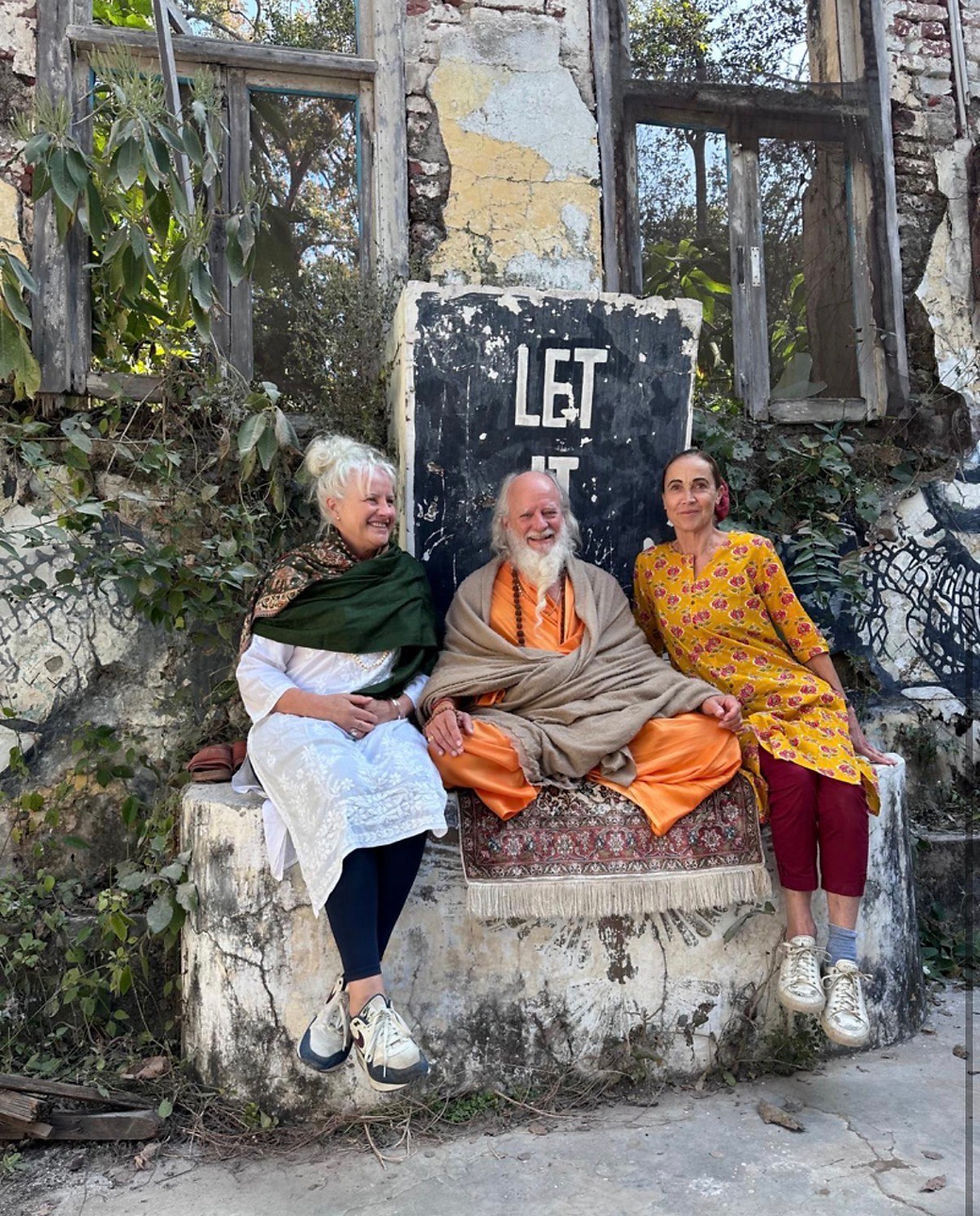
Today, Lil and I are at this ashram with him. His Western name is Thom, but all his followers call him Guruji, revered master.
I am here because Gigi said, “Mum, you must go to Guruji’s retreat in Rishikesh. It’s the greatest experience you will ever have,” so here I am on the banks of the Ganges with my guru Thom, although he doesn’t know he’s my guru, or that I’m here, or actually, he doesn’t even know I exist.
As a master of the Vedic, Thom gets to wear a silken robe spun by thousands of silkworms that don’t die and which is coloured with saffron, which costs more than gold ($5,000 an ounce), and a 24-ounce golden bracelet, which he won’t take off even for the nice Ayurveda massage lady. Thom says the bracelet is sacred because he made it so, and you can structure your universe to make things sacred, like taking off your shoes at the door.
He says when he’s not sitting cross-legged and barefoot in his golden gown with his golden bracelet beads and red flowers round his neck being a guru, he’s just a regular guy in Arizona in jeans and a tartan shirt and Birkenstocks with socks.
But he says, “I know I am not a regular guy, as I can see emotions others experience, like depression or worry, but I don’t experience these things because I’m in unity consciousness. I don’t run around saying, ‘Gee whiz, I’m in unity consciousness,’ but people feel it about me and come up to me and say, ‘I know you, you’re that guy, can I sit with you?’ I make myself fit in, as we all know what happened to the other guy!” Thom makes the sign of the cross.
Thom laughs and laughs at his joke because he lives in a state of bliss, which he says one can begin to experience after regular practice of meditation, 2 x 20 minutes daily, for 5 to 8 years. He’s been a student and master of the Vedic for 60 years and says if anyone is in a state of bliss, it is him. He laughs again and says, “I love cracking myself up, and you all give me an excuse to make myself laugh.”
There seems little doubt that people like Thom, the gurus of Eastern philosophy, have a calling.
Thom’s was an accident. He was hit by an ambulance when he was 10, broke every bone on his left side, and fractured his skull. His family were in the process of moving from the USA to Asia, and Thom was left behind, alone in traction at a veterans’ hospital with all the returned soldiers. They had been through horrendous things and didn’t tone it down because there was a boy in their midst.
When he was 15, Thom, who was by then just doing the regular surfie thing in California, happened to wander into a gathering where Maharishi Mahesh Yogi was preaching. He decided then and there that to follow the Maharishi was his destiny.
His parents, no doubt feeling guilty about leaving their child for a year unable to move in the company of a bunch of traumatised strangers, gave their son permission to go to India and study with the great guru. Thom did this for the next 25 years, with the next 35 years spent as a spiritual teacher, teaching people, like Lil and me, that the way to enlightenment is through meditation.
Thom set off for India by himself at 16. He made his way to Rishikesh, of which he writes: “When I arrived here, I thought I had landed in heaven, even with amoebic dysentery. All my siblings were on the conveyor belt of the Western world, and here I was in a place that was nothing short of magical.”
Thom began a program at the ashram the Maharishi had set up that was so rigorous he says his students could never do it today, as they haven’t dedicated their lives to him. He says the Maharishi had no private life and he was never alone. He and his students, however, are householders, with regular families and family life.
He says he had a weird and complex relationship with the Maharishi, whose only role was to drive the knowledge of the Vedic into him. “I confess,” he says, “there was a faintly competitive element in my relationship with my master. I refused to ask him anything, as I knew this was what he wanted me to do.”
He told me my program was to do the rounding (stretching and meditating and breathing for 30 minutes) 14 x a day in a little concrete igloo with no door. “I didn’t ask him for how long, and the uncertainty drove the lesson home. The temperature would drop to -30 degrees. One day, when I was doing the cobra position, a tiger walked past and I thought, ‘When in doubt, do nothing,’ but I knew it is not good when you see a tiger, as it means it is hungry.”
“I told my master, who said, ‘Very good. Mother Durga was here.’”
Eventually, after 500 consecutive days and 7,000 roundings, the Maharishi said,
“Enough.”
As Lil and I and 70 devotees from all over the world stand with Thom beside the Ganga, he says it shushes and roars as she bounds over boulders, and the sun always comes up on time.
I am transfixed to be so close to Thom on the banks of the Ganga.
I ask Lil if she thinks I should ask for a one-on-one session with Thom, and she says, “One million percent — he might fix you.” I take it in good spirits.


Comments