Ash and Lil do India - Blog 6 - To the Ganges
Updated: Feb 6
There are 70 of us here from all around the world, but mainly from the U.S. and Australia, and surprisingly about a third are men.
Every morning we do a sort of salutation to the sunrise, which feels to me a bit pagan. Then we have a group “rounding” at 7, which involves effortless stretching, then breathing in and out through alternate nostrils, then doing 20 minutes of meditation with a five-minute reflection after. Everything is to be effortless, charming, and without attachment. We all have a mantra, which is secret.
Then we go on an expedition until lunch from 12:30 to 2, which today we will have at a restaurant on the roadside. Then we have lectures and Q&A from Thom from 3 pm to 5 pm. When Thom comes in for a lecture, he arrives surrounded by his PA, who has grey hair in a bun and wears a full sari and looks meditative, as if advertising Thom’s brand; a large bristly American man who wears brightly coloured clothes and whose main job seems to be to help Thom up from his seated position at the end of a long two hours; and a manager, who carries Thom’s little carpet for him to sit on. We all shut up, stand up, put our hands together, and bow to him, and everyone is smiling madly, as I think they either are — or think they are — in a state of eternal bliss, which could be confused for being stoned.
We then have another rounding from 5 to 6 and lectures again from 8 till 10, when a lot of people fall asleep — but this, of course, is just following the charm. Then we all lie down for 30 minutes under a blanket and get screeched to sleep by some wailing. Thom says all spiritual journeys start with suffering and Indian music is visceral.
The food is vegetarian and I like it, but I am getting quite sick of it. A vegan really only eats chickpeas, vegetables, rice, porridge, noodles, and fruit. I think there’s ghee in the meals, but Thom says ghee is cholesterol-free, and what Thom says is gospel around here. I did sneakily check though, and AI says that ghee is not cholesterol-free and is a concentrated animal fat. No wonder Thom says AI will be obsolete this year if it dares contradict him like this.
Our outing today takes us to the banks of the Ganges, or Ganga, which it’s called if you’re cool, which is held in total and complete reverence here in India as the source of life. The river and the cows are the mothers of the Indian people.
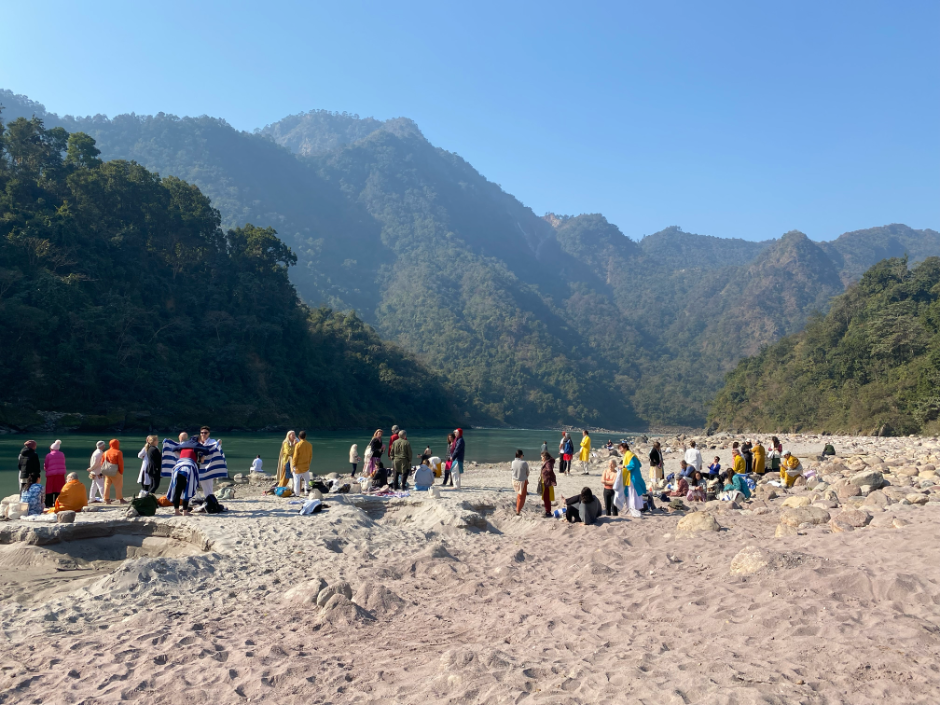
The Ganga is slate green, with transparent milky waves bouncing off boulders, working up the huge momentum to carry life-giving forces 2,500 kilometres across this vast continent. We are close to the source of the Ganges at the base of the Himalayas, surrounded by mountains — but the people dismiss these as mere hills, as the world’s highest mountains tower behind.
At the source of the river it is clean, with no bodies floating by. It is very swift, and there is a thriving business in this town: white-water rafting. I had always imagined the Ganges to be a quiet green river where tigers crouch down to lap at her waters, with their paws just touching the water’s edge.
The people are always paying homage to Mother Ganga, as they do to many other forms of life and gods. They bow at temples, light incense, hang flowers, bow at pictures, put little statues of the gods everywhere — including in the Ganges — so they may be blessed. They are very respectful. They are never in a hurry and always say “Namaste,” put their hands together, and give a little bow when they see you. They are always smiling, as if they have secret knowledge we in the West have lost, or never had, and this gives them contentment and a sort of smug spiritual superiority.
It seems much more authentic than the smiling state of my group, who have only been meditating for maybe one to seven years, while these people have been following the wisdom of their ancestors and their gods for 3,000 years.
As we stand on the banks of the Ganges, we see a rock painted red, and Thom says that is the home of a yogi who has gone walkabout. He says, “I know him well. I spent time in his little cave, which is in a hollow rock where you have to crouch to get in. He has a bed, a place to boil a kettle, and an altar. The only word he ever says is ‘Ananda’” — the Sanskrit word meaning bliss. (Two-thirds of English words come from Sanskrit), or so says Thom.
We visit another cave where it is said that Vashishtha Guha sat inside for 10,000 years, with his wife in another interconnecting cave. Thom said it felt like 10,000 years when he was sent to sit in this cave by the Maharishi — not as a punishment, but as part of his training to be a guru.
He was only allowed out in the morning to bathe, and his one meal a day was brought to him at 12. After that he had to sit and meditate. He never knew if it was day or night, and he was not allowed to lie down.
The family that brought Thom his one meal a day live here beside the cave, tending their cows and chickens, and have been caretakers of the caves for centuries. When Thom was here for his six-week program, he had taken a vow of silence, so only communicated with them through sign language.
We are invited to enter the dark cave and told not to make a noise. Westerners, Thom says, like to yahoo and make a big hoopla about things. He reminds us this is not a recreational site but a sacred one, and that anyone in unity consciousness doesn’t do gee-whizz.
Thom warns us to be careful as we enter the cave, as in the dark we might not see the yogis sitting along the cave walls meditating.
We enter the cave in a line. It is very dark and incense is burning. Thom is sitting at the end of the cave with a little flame. He asks us to put our hand on a little icon of the Shiva Lingam, where Shiva is given the form of a penis and Yoni (Mother Divine) a vagina. We bend our heads and Thom touches our hair and blesses us. There is the sound of sobbing. It is very mystical, awakening a part of us that belongs to a time long before we were born, but as always I am observing myself doing all this and feeling like a complete fraud.
We all go and swim in the Ganges, where you have to put your head under three times to be blessed. We have to completely cover ourselves up as we are at a sacred site. It is cold, but you don’t feel the cold — you just feel the magic of something given mystical powers, for, as Thom says, it is we who make something sacred. Thom says cold water means we are in the presence of God.
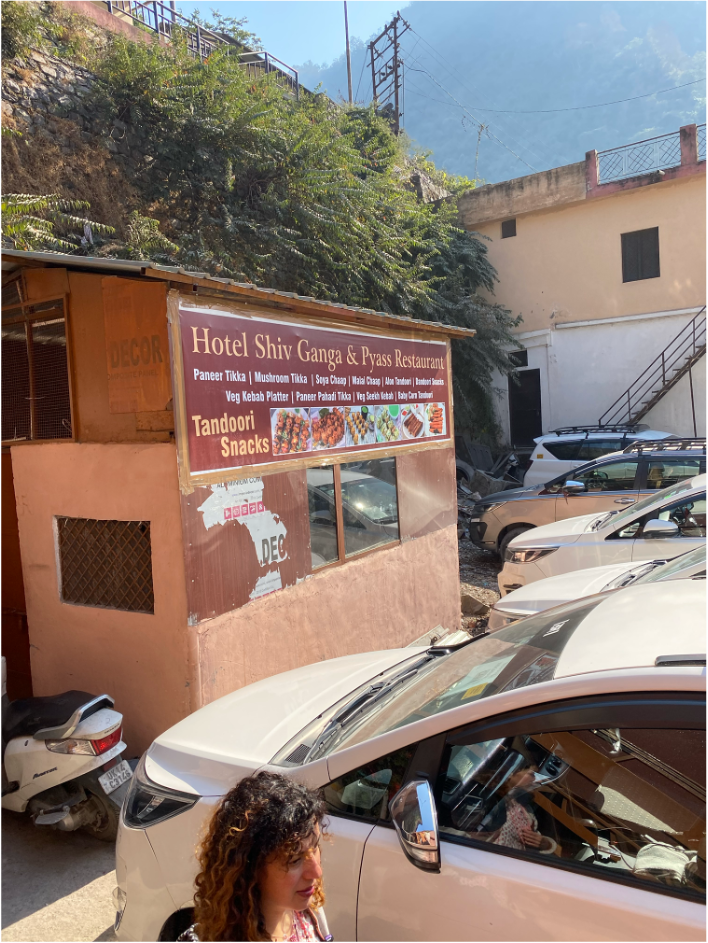
We eat at a lovely restaurant where, because we are last in the queue, we get to sit outside at the best seats. A lovely girl called Michelle shows me photos of her daughter, who looks just like Jettie grown up. She asks for my phone number, and then the next day she leaves and goes home, and her ex-roommate comes to me and Lil and says, in very German-accented English, “I feel it is me she doesn’t like and I have driven her away.” I think how we can’t help but be the protagonist in any drama that we have a part in. Lil and I try to help her by quoting Thom’s theory: why let “boo hoo no one likes me” get in the way of eternal bliss, but we don’t explain this quite as convincingly as Thom.
Thom’s lectures leap about like the Ganges on the boulders. He sits at the front in his saffron robe. He is remarkably unlined and golden brown, but cultivates the wise old man look — as, let’s face it, he is a brand. He has certainly worked very hard to get to where he is. He’s bloody good at what he does, and everything he says is seriously worth hearing — it’s a spiritual sort of common sense which eventually, he promises, with meditation will make you high (blissful) without any drugs.
Today Thom talks about Siddhartha Gautama, who was given the name Buddha (the Awakened One) 100 years after he died. He was a royal prince of Northern India up to Nepal. Buddha, Krishna, etc. He says that back then all the great yogis came from wealthy families, as they had everything they needed and wanted except enlightenment. This reminds me a bit of our group.
Buddha’s father wanted him to be king, so shut him in the palace so the small boy wouldn’t see that his father’s kingdom was full of suffering: old people, sick people, starving people. The little boy escaped, however, and saw the suffering. He decided his purpose was to question the meaning of life and the nature of suffering. He sat under a Bodhi tree until he found the no-thing-ness. With deep meditation he achieved enlightenment and was one with the universe (unity consciousness), and in a great hallway of mirrors he saw himself in all stages of life — beetle, reptile, cow — and he took all of them with him to Nirvana, even the blade of grass where it all began.
Buddha never ever mentioned the name God. He said simply that there is a state you can go to deep inside yourself where you will find Nirvana.
If Thom gets a bit tired of the spiritual side of it all, he dives into quantum theories and says everyone, including all past and present Nobel Prize winners, is onto this quantum theory to explain cosmic consciousness, and AI will be extinct in 2026 as we realise at last that the human brain is the greatest computer of all — we just have to know how to tap into it. Thom says science has proved the divine, which in a way seems counter-intuitive.
He says 2026 will be the year there will be a switch all over the world from collective dominance of masculine consciousness to female consciousness, which will finally come into its own. The males of our species will feel threatened, but it is always what is most relevant that determines evolution, and evolution means males will no longer be relevant. However, we must respect the role of males in the past, like the umbilical cord — they have served a purpose. Thom says as males become less relevant they will become more noisy and grasping.
Thom says we must pay attention. The key to life is what is coming.
And he draws an analogy with Taylor Swift of all people, saying shared experience is the greatest driver in life.
When he feels we have had enough of science, he jumps back to the remarkable things he has done. He was sent by the Maharishi to Kampuchea, now Cambodia, to open a school in Phnom Penh and to Manila to tell President Marcos, “It is time for you to go.”
Having thus assured us he is well worth listening to, we go to lie down and listen to Indian music, which, although I’m tone deaf, makes me wish I actually were deaf.




Ashleigh, this is hilarious. You made me spit out my tea with laughter. Don't let Thom read your blog (although he surely wouldn't mind, because that would be counted as "boo hoo no one likes me").